Budding Egyptian women artists, Nada Baraka and Esraa Elfeky, discuss their latest exhibition at Tabari Artspace, Across A Velvet Horizon
By Laura Cherrie Beaney
On view at Tabari Artspace from 20 February until 17 March, Egyptian artists Nada Baraka and Esraa Elfeky have worked together on a dual exhibition, Across A Velvet Horizon. In terms of its direction, it’s a show that resists clarity, offering instead a world of fragments, erasures, and open-ended narratives. The works on view refuse the comforts of resolution, inviting visitors to step into the role of archaeologists and storytellers, piecing together meaning from what remains. The exhibition space, much like memory itself, feels unstable, full of gaps, omissions, and reimaginings.
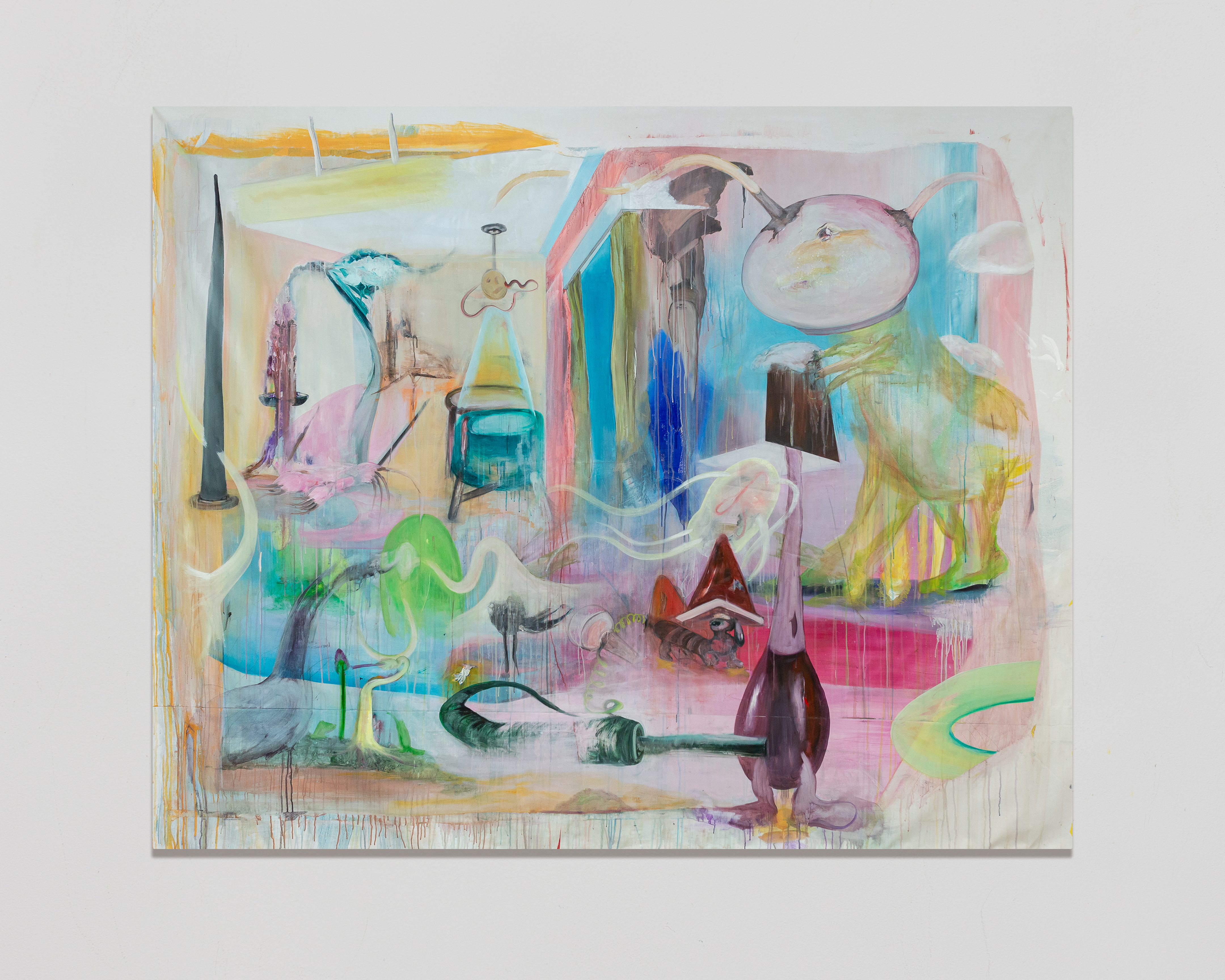
“The unknown is central to my practice,” says Baraka. “My work navigates around dream strategy, where memory is in flux. I’m drawn to the gaps—the stories that have been erased, the textures of the past that resist coherence.” Her paintings, rich in layered brushwork and muted, otherworldly palettes, hover between abstraction and figuration. They pull from her grandfather’s archive—old letters, ephemeral notes, relics of personal history—but nothing is whole, nothing is clear. “The past is always slipping through our fingers,” she adds.

Nada Baraka. The edge of saudaude. 2025. Arcylic and oil on canvas. 160x120cm
Elfeky, working with fabric, leather, and thread, approaches memory through materiality. Her sculptures recall landscapes that hold history—the way the desert, for example, preserves traces of lost worlds. “The land is a silent witness,” she says. “It remembers what we forget.” Some of her works stretch across the gallery floor like unearthed fossils, remnants of something ancient yet speculative. Others hang, suspended in liminal space, caught between past and present, presence and absence.
A quote from Friedrich Nietzsche’s On the Genealogy of Morals feels particularly relevant to the exhibition’s enquiries: “What did we actually experience just now? Who are we actually?” Baraka and Elfeky ask viewers to sit with uncertainty, to confront the instability of perception, to embrace the search rather than the answer.

Nada Baraka. Harness the mass. 2025. Arylic and oil on canvas. 190x260cm
“There’s an archaeological quality to the exhibition,” Baraka acknowledges. “I love the idea of the viewer as an active participant, not just consuming but interpreting, connecting the dots. Her wooden structure in the gallery, for example, serves as a kind of abstract map, guiding the audience through the show while leaving space for personal readings.”
Elfeky expands on this, describing her largest work, The Blue Wadi Resurrection, a vast 11.5-metre sculpture that sprawls across the floor like a ruin waiting to be deciphered. “The exhibition is an act of excavation,” she says. “The pieces don’t tell a single, definitive story. They invite speculation, reconstruction.”

Sketch by Esraa Elfeky
A conversation between personal and collective memory runs throughout the exhibition. Baraka’s paintings contain snippets of text—phrases from postcards and old letters—hidden beneath layers of paint, barely legible. “Even the most personal recollections are subject to distortion, retelling, forgetting,” she says. Meanwhile, Elfeky’s sculptures, built from materials that bear traces of past use, suggest the body as a site of history. “Fabric, for me, is like skin—it carries memory, it holds time,” she reflects.
Baraka, whose influences range from interior design to philosophy, crime fiction to vintage manga, is drawn to the tension between the familiar and the uncanny. “I’m fascinated by how design elements—like colour or texture—can transport you to another time,” she says. Elfeky, inspired by Ibn Battuta’s travel writings and geological deep time, approaches history as cyclical. “I believe that everything that will happen in the future has, in some form, already occurred in the past,” she says. “The desert was once underwater; fossils of marine life are buried beneath the sand. My works exist in this in-between space—neither fully past nor present, neither completely real nor entirely fictional.”

Sketch by Esraa Elfeky
The exhibition resists closure. “We live in a world obsessed with clarity, categorisation, closure,” Baraka notes. “But history, memory, and identity don’t work like that.” Elfeky agrees. “Across A Velvet Horizon is about embracing the unknown, sitting with uncertainty, allowing things to remain unresolved.”
When asked what they hope audiences take away from the exhibition, their answers remain fittingly open-ended. “A sense of possibility,” says Baraka. “I hope they leave with more questions than they came with.” “A curiosity for what lies beneath the surface,” adds Elfeky.
Across A Velvet Horizon runs at Tabari Artspace from 20 February until 17 March.
Lead image: Nada Baraka. Flirting with time. 2025. Acrylic and oil on canvas. 235x195cm