


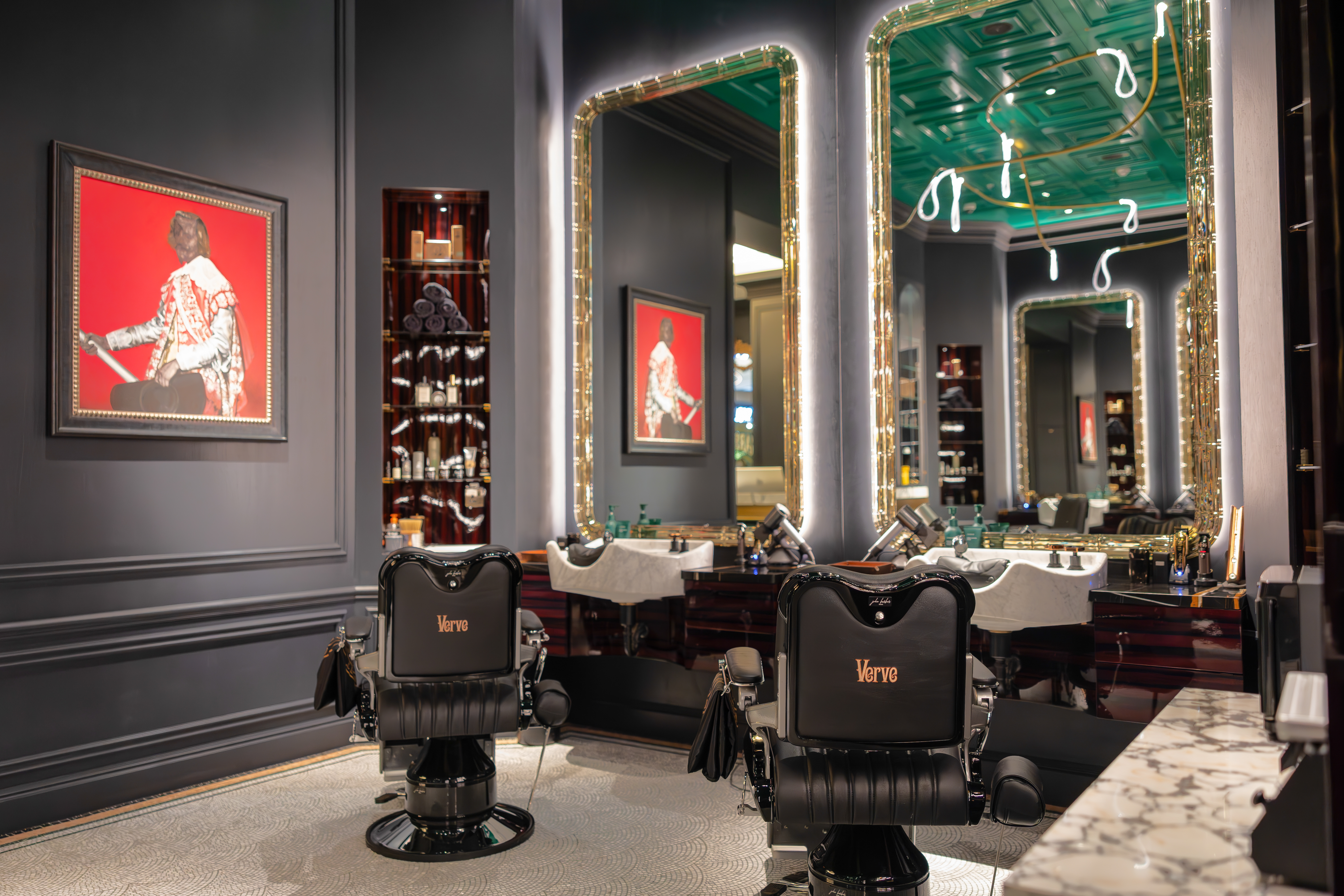
At Verve Barbershop, grooming is elevated into a considered ritual where design, craft, and atmosphere converge
In a city that thrives on velocity and spectacle, it is rare to encounter a space that invites stillness with such quiet authority. At Verve Barbershop, set within Dubai Mall’s Fountain Views, the act of grooming is reimagined not as maintenance, but as a deliberate pause; a recalibration of self in the midst of Dubai’s relentless momentum.
Conceived by Celal Girisken, whose career traverses the worlds of high fashion, cinema, and brand strategy, Verve is less a barbershop and more a composed environment of intention. Here, design and service operate in tandem, shaping an experience that feels as considered as it is immersive. The space does not shout for attention; instead, it unfolds gradually, revealing its nuances through material, light, and atmosphere.

Founder of Verve Barbershop, Celal Girisken
The interiors are layered with references that quietly signal permanence and craft. Underfoot, intricate mosaics evoke a lineage of European artistry, grounding the space in a sense of heritage. Mirrors, framed with sculptural precision, do more than reflect—they frame moments, capturing the subtle evolution of a client’s transformation. Yet it is the lighting that defines the mood most profoundly. Calibrated with near-clinical precision, it shifts in tone and intensity, alternately softening and sharpening perception. The result is a space where every detail, every contour, every line, is revealed with clarity, yet never stripped of warmth.
This interplay between environment and experience is central to Girisken’s philosophy. Having honed his eye within the ateliers of Giorgio Armani and Chanel, and later on the exacting sets of films like Mission: Impossible – Dead Reckoning, he brings a distinctly narrative sensibility to the act of grooming. At Verve, the chair becomes a stage of sorts – one where identity is subtly refined, rather than overtly reinvented.

The service itself reflects this layered approach. Each appointment unfolds as a sequence of gestures, both precise and sensory. The haircut is approached architecturally, shaped with a sensitivity to form and proportion. Traditional elements – such as the ritual of hot towels or the discipline of a straight razor shave – are preserved, yet elevated through a heightened awareness of detail. There is a tactile richness to the experience, from the products selected to the choreography of the barber’s movements, that reinforces a sense of care rarely afforded in everyday routines.
Art, too, plays a defining role in this environment. Works by Simone Parise line the walls, offering a visual dialogue that mirrors the ethos of the space. His compositions, which reinterpret classical portraiture through a contemporary lens, echo the barbershop’s own balance between tradition and modernity. The result is a seamless conversation between disciplines – art, design, and grooming – each informing the other.

Yet beyond its aesthetic and technical achievements, Verve gestures toward something more cultural. It reframes grooming as an act of awareness, a moment in which external presentation aligns with internal clarity. In a landscape often defined by excess, it proposes a different kind of luxury – one rooted not in display, but in precision, restraint, and intention.
In this sense, Verve is not merely shaping appearances. It is shaping presence.


